


Useful Information about Old Ibanez and Maxon Pedals
Ibanez was a brand of effects pedals (and guitars, and ...). Other companies manufactured most of those old Ibanez products. In particular, Maxon made many/most of the vintage Ibanez pedals. This article focuses on a couple of the distortion and overdrive pedals, but the general principles apply to other types of pedals, such as analog delays.
One reason you may find this information useful might not be readily apparent. There are cases where there are "twin" Maxon and Ibanez pedals - identical circuits - where one brand of the pedal got famous and very expensive and the other did not. If you know some of this information, you can get a pedal that is identical in sound for a very small fraction of the cost of its famous twin... IYKYK!
In most cases, there is both an Ibanez and Maxon version of the same exact pedal. The only differences are in the metal box and the paint and graphics. On the inside, they are the same Maxon boards, with the same components, built the same way, pretty much identical. They were built in the same place by the same people. Of course, just like most pedals back in those days (60's through 70's and into the 80's) there were occasional component shortages or other supply problems that resulted in some component swapping. That was unintentional. They were meant to be the same. The result is that if you open up an Ibanez pedal and its Maxon twin, it is possible to see some component differences. That is just a "manufacturing chance" thing, not generally a desired design or build difference that was intended. Most of those changes should be nearly impossible to hear when you play. For the purposes of this discussion, the Ibanez and Maxon twin pedals are identical in sound, differing only in their external appearance.
So let's talk about a few specific models.
The Ibanez OD-850 is identical to the Maxon D&S OD-801. There were three versions of both (same versions of each being identical). Actually, Maxon had a v4, a reissue of their v1. This circuit is a Big Muff Pi clone with a couple of small changes in the Tone section from the Big Muff. It even uses the same transistors found in an early version of the Big Muff Pi. These pedals sound like a Big Muff Pi, as you would expect. There were some slight variations in components in different manufacturing runs, but the same circuit layout, boards, key values, etc seem pretty consistent. All were made by Maxon on Maxon boards. The only intentional differences being in the cases and graphics.
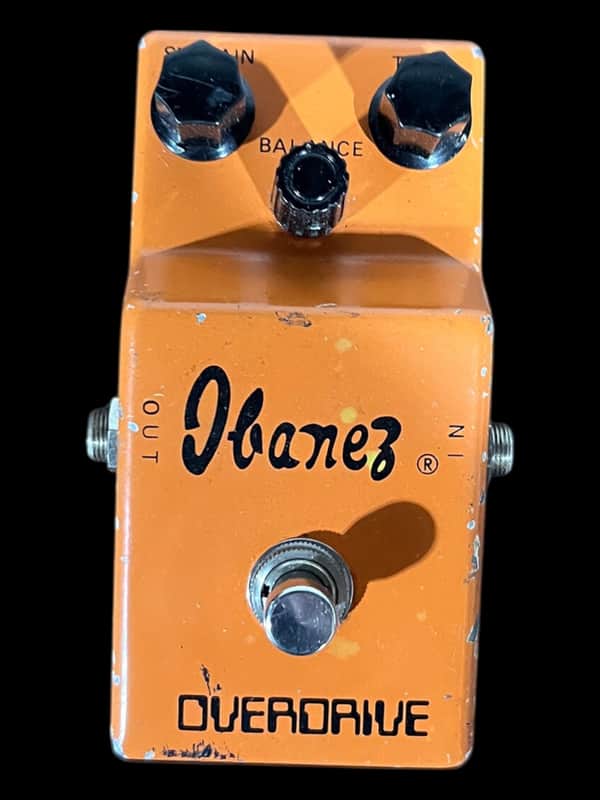
Ibanez OD-850 v1 - very expensive

Maxon D&S OD-801 v1 - same circuit, very affordable
The Ibanez Overdrive II OD-855 v1 “Flying Fingers” is a simple opamp pedal similar to an MXR Distortion+ or a Rat. It is different from the other Overdrive II OD-855 models. It does not have the “OD-855” printed on the top. It has two opamp stages provided by various makes of 1458 opamps, but no transistor input or output stages. It has the Tone section after the clipping and distortion, which is a common configuration. It is a very simple circuit, making it a good platform for modifications. These sound similar to a Distortion+. The two opamp stages and the mids hump are steps along the path to the eventual Ibanez Tubescreamer. There is no direct Maxon counterpart for this pedal.
Most Ibanez Overdrive II OD-855’s are identical to Maxon D&S II OD 802. These are v2 and v3 of the Ibanez OD-855 pedal, both with “OD-855” printed on the top. These are a precursor to the Tubescreamer, but slightly different. They have two opamp sections provided by the well-known 4558 opamp, with the Tone section ahead of the distortion/clipping section, which was unusual in OD and distortion circuits. They also have input and output transistor stages. Again, these pedals were made by Maxon, and are identical except for the cases and graphics, although minor component differences occurred in different manufacturing runs. These sound more like a Tubescreamer. They have the same 4 stages as a Tubescreamer - input transistor buffer, opamp tone and distortion stages, and output transistor stage, but the Tone and Distortion stages are reversed from the Tubescreamer. The next version of the circuit changed the order of those stages and tweaked the circuit a bit and became the TS-808 Tubescreamer. This circuit is also similar to the BOSS OD-1, which I think came before these Ibanez pedals.
The MXR Distortion II is completely different from all these other pedals, with 4 knobs and AC power.
The Ibanez OD-9 is famed for its scarcity and very high price. The Ibanez OD-850 v3 was apparently a transition circuit to the OD-9, using the same board. There is some discussion that the OD-850 v3 and OD-9 were identical. It's difficult to say, given the scarcity of OD-9 pedals (which may have only been introduced in France). The OD-9 didn't become a product. It was stopped or canceled before it went to mass production. It seems unlikely they would introduce an OD-9 that was identical to the OD-850 v3. Perhaps the same circuit with some swapped component values? I've only seen discussion from one player who had played both (in France, oddly). He said they did not sound the same. Different Big Muffs don't sound the same, either. Maybe Ibanez didn't need another Big Muff clone in its product line.